
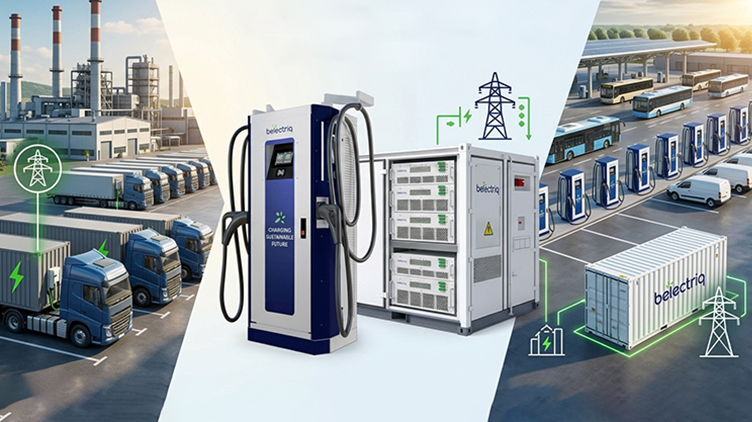
The rapid deployment of high-power EV charging stations is changing the requirements of electrical infrastructure. DC fast chargers rated at 150 kW, 240 kW, 350 kW and above can create significant power demand, particularly when multiple vehicles are charging simultaneously.
For charging station operators, fleet operators, commercial facilities, and CPOs, the available grid connection may not always be sufficient to support the required charging capacity. Increasing transformer capacity or upgrading the utility connection can also involve significant costs, long approval timelines, and infrastructure modifications.
A Battery Energy Storage System (BESS) can help address these challenges by acting as an energy buffer between the electrical grid and EV chargers.
By combining BESS with high-power EV charging infrastructure, charging stations can manage peak demand, reduce grid loading, optimize energy consumption, and potentially defer expensive electrical infrastructure upgrades.
What Is BESS for EV Charging?
A Battery Energy Storage System (BESS) is an energy storage solution that stores electricity and supplies it when required.
In an EV charging application, BESS can charge from the grid during periods of lower demand and discharge when EV chargers require high power.
A typical system can include:
- Battery modules
- Battery Management System (BMS)
- Power Conversion System (PCS)
- Energy Management System (EMS)
- Thermal management system
- Protection and safety systems
- Monitoring and communication systems
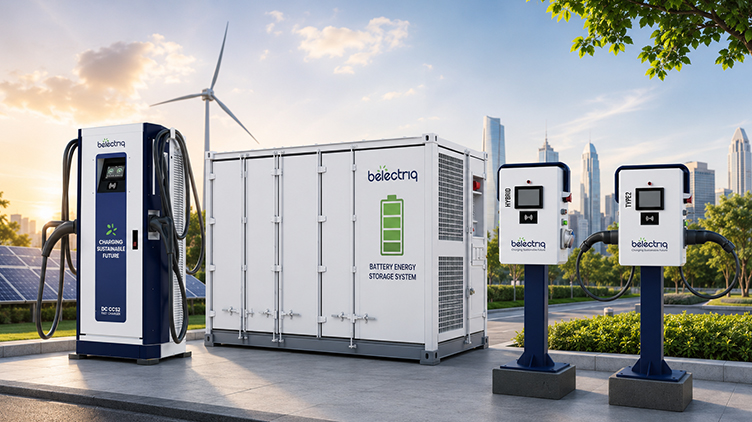
The BESS can be integrated with EV chargers and other energy sources such as solar PV to create a flexible energy management system.
Typical configuration
Grid → BESS → EV Chargers
or
Solar PV + Grid → BESS → EV Chargers
This architecture allows the available grid capacity to be used more efficiently while the battery supplies additional power during periods of high charging demand.
Why Do High-Power EV Chargers Create Grid Constraints?
High-power DC chargers can require substantial instantaneous power. When several chargers operate simultaneously, the total demand can become significantly higher than the available grid connection.
For example:
Suppose a charging station has:
- 2 × 150 kW DC chargers
- Maximum charging demand = 300 kW
If the existing facility is already consuming significant power, the additional EV charging load can exceed the available transformer or sanctioned capacity.
This can result in:
- Transformer loading
- Voltage fluctuations
- Increased peak demand
- Higher electricity demand charges
- Grid connection limitations
- Delays in charger deployment
- Expensive transformer or electrical infrastructure upgrades
Instead of immediately increasing the grid connection capacity, a BESS can be used to provide additional power during high-demand charging periods.
How Does BESS Help EV Charging Stations?
BESS acts as a power buffer between the grid and the EV chargers.
During periods of low electrical demand, the battery can be charged from the grid. When EV charging demand increases, the BESS can discharge and supply a portion of the required power.
For example:
Without BESS
EV charger demand: 350 kW
Grid supplies: 350 kW
With BESS
EV charger demand: 350 kW
BESS supplies: 200 kW
Grid supplies: 150 kW
In this simplified example, the grid sees only 150 kW instead of the full 350 kW charging demand.
The actual operating strategy depends on the site’s load profile, grid connection, battery power rating, energy capacity, tariff structure, and charging requirements.
Peak Shaving for EV Charging
One of the most important applications of BESS is peak shaving.
Peak shaving means reducing the maximum power drawn from the grid by using stored battery energy during periods of high demand.
Consider a charging station where the EV charger requires 350 kW.
Without BESS:
Grid demand = 350 kW
With BESS:
EV charging demand = 350 kW
BESS contribution = 200 kW
Grid contribution = 150 kW
The BESS supplies the difference between the required charging power and the desired grid power limit.
This can help:
- Reduce peak grid demand
- Reduce transformer loading
- Manage demand charges where applicable
- Make better use of existing electrical infrastructure
- Improve the feasibility of high-power charging installations
How BESS Can Defer Grid Infrastructure Upgrades
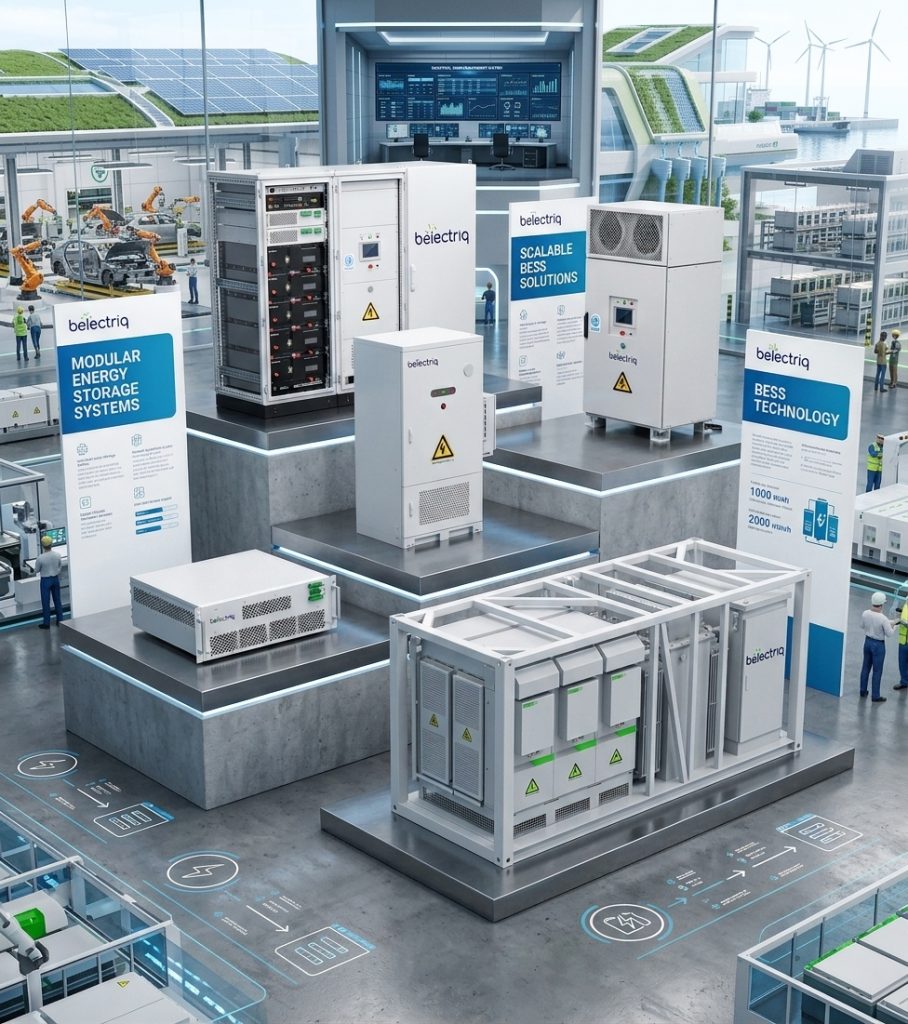
One of the major advantages of BESS for EV charging is the potential to defer electrical infrastructure upgrades.
Consider a simplified site:
- Existing facility load: 300 kW
- New EV charger: 350 kW
- Existing grid infrastructure: limited capacity
If the facility and charger operate simultaneously, the combined demand can exceed the site’s available capacity.
With an appropriately sized BESS, the battery can supply part of the EV charging demand while the grid supplies the remainder.
For example:
Existing facility load: 300 kW
EV charger demand: 350 kW
Total potential demand: 650 kW
With BESS:
BESS contribution: 200 kW
Grid contribution to EV charger: 150 kW
The site can therefore limit the additional grid demand, subject to the site’s actual electrical design and operating conditions.
BESS and Power Quality for EV Charging
Modern BESS systems use advanced power electronics that can respond rapidly to changes in electrical demand.
Depending on the system architecture and inverter capabilities, BESS can support:
- Voltage regulation
- Power factor management
- Load balancing
- Reduction of voltage fluctuations
- Fast active power response
- Integration with power quality equipment
- Harmonic performance management through suitable inverter and filter design
For sites with sensitive industrial loads or demanding electrical environments, BESS can be combined with dedicated power quality solutions such as Active Power Filters, SVG/VAR compensation systems, or other power-conditioning equipment.
For harmonic performance, system design should consider applicable requirements such as IEEE 519 and relevant IEC standards.
Energy Arbitrage for EV Charging
Another potential application of BESS is energy arbitrage.
Energy arbitrage involves charging the battery when electricity is relatively less expensive or when grid demand is lower, and using stored energy when electricity costs or site demand are higher.
For an EV charging station, this can help operators optimize energy consumption.
Potential benefits include:
- Reduced energy costs
- Better utilization of available grid capacity
- Improved charging station economics
- More effective use of solar energy
- Reduced exposure to peak electricity periods
The financial benefit depends on local electricity tariffs, demand charges, battery efficiency, degradation, operating strategy, and market conditions.
Combining Solar PV, BESS and EV Chargers
BESS can also be integrated with solar PV systems.
A typical architecture can be:
Solar PV → BESS → EV Chargers
with the grid also connected to the system.
During periods of solar generation, excess energy can be stored in the battery. The stored energy can then be used to support EV charging when solar generation is unavailable or insufficient.
This can provide:
- Better utilization of solar generation
- Reduced grid dependency during selected periods
- Improved energy management
- Greater flexibility for EV charging
- Potential reduction in electricity costs
The optimal control strategy depends on the site’s energy demand and charging profile.
How Much BESS Capacity Is Required for an EV Charging Station?
There is no single BESS size that is suitable for every EV charging station.
The required BESS power and energy capacity depend on several factors, including:
1. Number of EV Chargers
A station with four 150 kW chargers can potentially require significantly more power than a site with one 60 kW charger.
2. Charger Power Rating
The maximum charger power directly influences the required BESS power rating.
3. Grid Connection Capacity
The available grid capacity determines how much power must be supplied by the BESS during peak charging periods.
4. Charging Profile
Actual vehicle arrival patterns, charging duration, and simultaneous charging behavior are critical for determining battery requirements.
5. Desired Peak-Shaving Level
The required BESS capacity changes depending on the target grid power limit.
6. Backup Requirements
If the BESS is also expected to provide backup power, additional energy capacity may be required.
Example
Consider:
4 × 150 kW EV chargers = 600 kW maximum charger demand
Depending on the site’s grid capacity and operating strategy, a BESS could be designed with a power rating in the range of several hundred kilowatts and an energy capacity ranging from hundreds of kWh to several MWh.
However, this is only an illustrative example. Actual BESS sizing should be based on a detailed load profile and system design study.
Economic Benefits of BESS for EV Charging
A properly designed BESS can provide multiple economic benefits for EV charging operators.
Reduced Peak Demand
Peak shaving can help reduce maximum grid demand and potentially lower applicable demand charges.
Deferred Infrastructure Investment
BESS may reduce the immediate need for transformer upgrades or increased grid connection capacity.
Energy Cost Optimization
Energy arbitrage can help shift electricity consumption to more favorable periods.
Better Charger Utilization
BESS can enable high-power charging even where the available grid connection is more limited.
Renewable Energy Integration
Solar PV and BESS can be coordinated with EV charging to improve energy utilization.
Additional Grid Services
Depending on local regulations and market structures, BESS may also participate in services such as:
- Frequency response
- Voltage support
- Load balancing
- Reserve services
- Renewable energy integration
The availability and commercial value of these services vary by market.
Practical Example: BESS for a High-Power EV Charging Station
Consider a commercial EV charging site with:
- Grid connection: 500 kVA
- Existing site load: 300 kW
- DC fast charger: 350 kW
If the existing load and EV charging demand occur simultaneously, the potential site demand can reach:
300 kW + 350 kW = 650 kW
This may exceed the practical operating capability of the existing electrical infrastructure.
Now consider a BESS capable of supplying 200 kW to the EV charger.
During peak charging:
EV charger demand = 350 kW
BESS supplies = 200 kW
Grid supplies approximately = 150 kW to the charger
The total grid demand would then be approximately:
Existing load 300 kW + EV charging grid contribution 150 kW = 450 kW
This simplified example illustrates how BESS can reduce the grid power requirement during high-power charging.
The final design must account for power factor, transformer loading, protection coordination, BESS efficiency, battery state of charge, thermal conditions, and the actual site load profile.
Key Design Considerations for BESS-Based EV Charging
Before installing a BESS for an EV charging station, several technical, economic, and safety factors should be evaluated.
Technical Considerations
- EV charger power rating
- Number of chargers
- Site load profile
- Transformer capacity
- Grid connection limit
- BESS power rating
- BESS energy capacity
- Battery chemistry
- PCS efficiency
- EMS control strategy
- Power quality requirements
- Protection coordination
- Communication and monitoring
Economic Considerations
- Battery and PCS cost
- Installation cost
- Electricity tariff
- Demand charges
- Battery degradation
- Expected operating cycles
- Grid upgrade costs
- Potential revenue from grid services
- Expected return on investment
Safety Considerations
A BESS installation should also incorporate appropriate:
- Battery monitoring
- Thermal management
- Fire detection and protection
- Electrical protection
- Isolation systems
- Emergency shutdown provisions
- Environmental protection
- Compliance with applicable local regulations and standards
Why BESS Is Becoming Important for High-Power EV Charging
As EV charging moves toward higher power levels, the challenge is no longer only about installing a powerful charger. The electrical infrastructure supporting that charger also needs to be capable of handling high and rapidly changing loads.
A BESS provides an additional layer of flexibility.
Instead of designing every charging site around the highest possible instantaneous grid demand, operators can use intelligent energy management to coordinate:
Grid + BESS + EV Chargers + Solar PV + Site Loads
This approach can make high-power charging infrastructure more adaptable to existing electrical capacity.
Conclusion
BESS for EV charging provides a practical approach to managing the grid constraints associated with high-power EV charging infrastructure.
By acting as a power buffer, BESS can support peak shaving, load management, energy optimization, renewable integration, and potential grid infrastructure deferral.
For charging stations with limited grid capacity, integrating a properly sized BESS can help support higher charging power without relying solely on immediate grid upgrades.
As EV charging networks continue to expand and charger power levels increase, the combination of high-power EV chargers, BESS, intelligent energy management, and power quality solutions can play an important role in developing flexible and efficient charging infrastructure.
Belectriq provides EV charging and energy solutions designed for the evolving requirements of electric mobility. A properly engineered combination of EV charging infrastructure and energy storage can help businesses optimize available electrical capacity and prepare their charging infrastructure for growing power requirements.
Frequently Asked Questions About BESS for EV Charging
1. What is the main challenge of installing high-power EV chargers?
High-power EV chargers can create large instantaneous power demands. Multiple chargers operating simultaneously may increase transformer loading, peak demand, voltage fluctuations, and the need for electrical infrastructure upgrades.
2. What is a Battery Energy Storage System (BESS)?
A BESS is a rechargeable energy storage system that stores electrical energy and supplies it when required. It typically includes batteries, a BMS, PCS, EMS, cooling, protection, and monitoring systems.
3. How does BESS help EV charging stations?
BESS supplies part of the EV charging load during periods of high demand. The battery can charge during lower-demand periods and discharge when the EV chargers require additional power.
4. What is peak shaving in EV charging?
Peak shaving is the process of reducing the maximum power drawn from the grid by using stored battery energy to supply part of the charging demand.
5. Can BESS reduce the need for grid upgrades?
In some applications, yes. By limiting the maximum grid power drawn by EV chargers, BESS can potentially defer transformer or grid connection upgrades. The feasibility depends on the site’s load profile and electrical infrastructure.
6. Can BESS improve power quality?
Depending on the PCS and system architecture, BESS can support voltage regulation, fast active power response, power factor management, and other power management functions. Additional power quality equipment may be required for specific harmonic or reactive power requirements.
7. Can BESS work with solar power?
Yes. BESS can store excess solar energy and use it later to support EV charging or other site loads.
8. How is BESS capacity selected for EV charging?
BESS sizing depends on charger power, number of chargers, grid capacity, site load, charging patterns, desired peak-shaving level, backup requirements, battery technology, and operating strategy.
9. What are the economic benefits of BESS for EV charging?
Potential benefits include reduced peak demand, lower applicable demand charges, energy cost optimization, deferred infrastructure upgrades, improved utilization of charging capacity, and better integration of renewable energy.
10. What is energy arbitrage?
Energy arbitrage involves charging a BESS when electricity costs or grid demand are relatively low and discharging it during higher-cost or higher-demand periods.
11. What grid services can BESS provide?
Depending on the local electricity market and regulations, BESS can potentially provide services such as frequency response, voltage support, load balancing, reserve services, and renewable energy integration.
12. What are the key BESS design considerations?
Key considerations include charger load profile, grid capacity, transformer rating, battery chemistry, PCS sizing, EMS strategy, thermal management, protection, fire safety, battery monitoring, operating costs, and applicable regulations.
13. Can BESS support a 240 kW or 350 kW EV charger?
Yes. BESS can be designed to support high-power DC chargers, including 240 kW and 350 kW-class systems. The required BESS power and energy capacity depend on how much of the charger load needs to be supported and for how long.
14. What is the overall benefit of BESS for EV charging?
BESS can help overcome electrical capacity limitations by supplying additional power during high-demand periods. This can support peak shaving, energy management, renewable integration, and potentially defer certain grid infrastructure upgrades.

Leave a Reply